Somewhere to start
How much money would actually make me feel secure?
Money is rarely only arithmetic. It carries safety, standing, freedom, obligation and whatever your family taught you about it before you were old enough to argue.
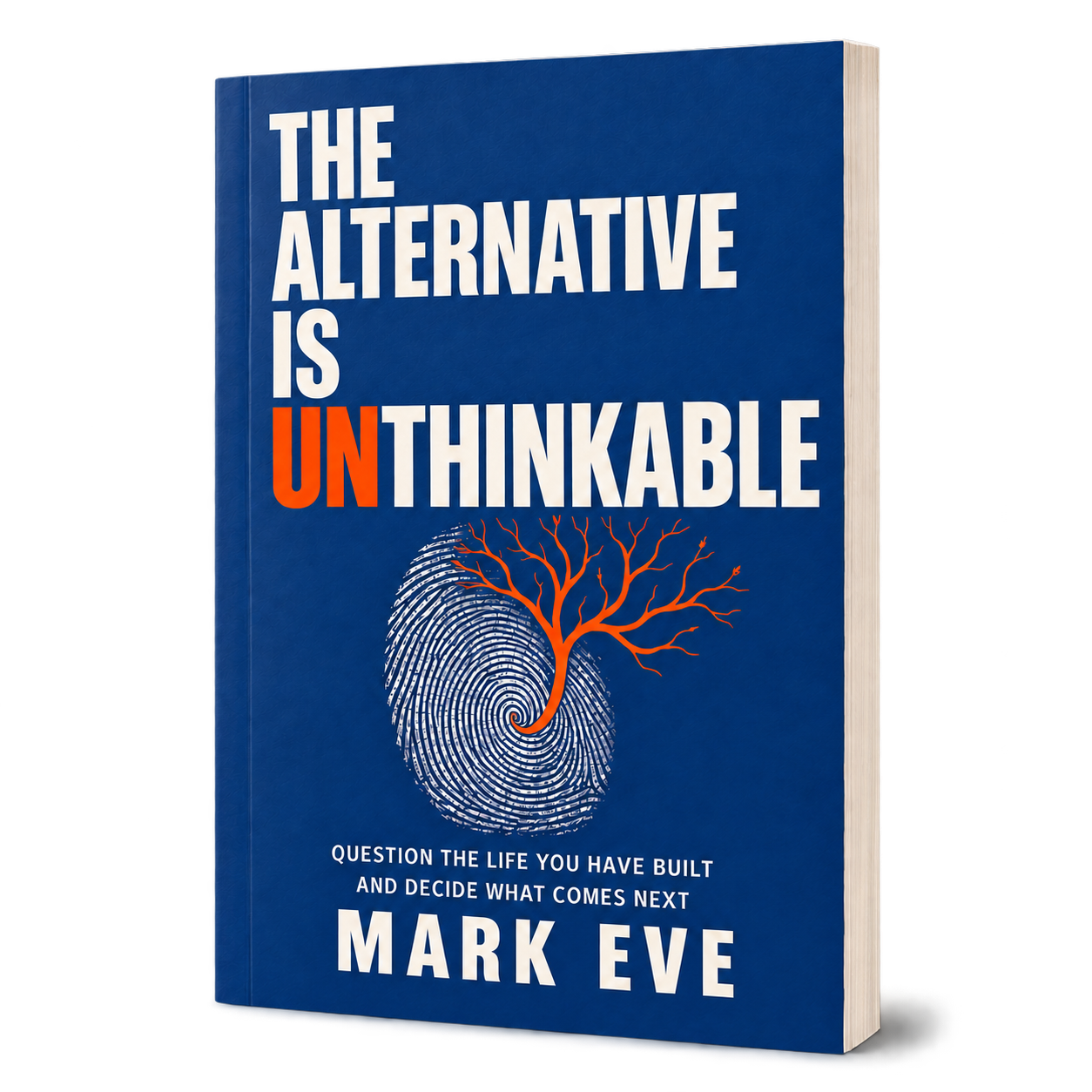
This question comes from The Alternative Is Unthinkable.
Question the life you have built and decide what comes next.
The complete digital book is available from TAIU for £7.99. Read it on TAIU or download it for Kindle and other e-readers. Your purchase also includes full access to The Clearing.
One payment. No subscription.
A place to talk through what is actually going on, by voice or in writing.
One of the five branches: the life being lived now.


Meet Alto
Start anywhere. Say what is happening and work out what the money question underneath it actually is.
Start with what is on your mind. You can leave the conversation there or save what matters.
You can begin without payment. Full access to Ask Alto, the sessions, workshops, journal and My Tree is included when you buy the book.
Nothing is kept unless you choose to keep it. You can start without an account, and an account is what lets you save what you write.
Ask Alto
Hi, I’m Alto. What would you like to talk through?
Start with what is true
Every route below is free to open. There is no test, no diagnosis and no score at the end.
An account is only needed to keep what you write, and no card is asked for.
These are starting points rather than a test. Each one opens a session, which is a conversation that helps you work something through. Nothing is stored unless you are signed in, and you can stop at any point.
Under financial pressure
Debt, an urgent bill, housing pressure or an income that does not cover the month. Free money advice comes first, and the session is there afterwards if you want it.
Free money advice first
Enough and security
What enough would actually mean for you, where that idea came from and why having money may not have produced the security you expected.
Session: What does money mean to me?
Free session
The life I am paying for
What earning, spending and staying secure are costing you in time, health, work and relationships, and whether the exchange still makes sense.
Session: Money and time
Free session
If there genuinely is not enough right now
Thinking it through does not pay a bill. If money is short this week, free money advice comes first and it is there for exactly this.
- MoneyHelper. Government backed and free. Its debt advice locator finds a free adviser near you: https://www.moneyhelper.org.uk/en/money-troubles/dealing-with-debt/use-our-debt-advice-locator
- Citizens Advice. Free advice on debt, benefits and housing.
- StepChange. Free and independent debt advice.
- National Debtline. 0808 808 4000, free and independent.
TAIU is reflection, not financial advice. Nothing here replaces a qualified adviser.
Separate what is urgent from what is frightening is a free session for the part that is yours to decide this month. It is there when the practical help is in hand.
Money touches other parts of a life
Sometimes the money question sits next to something else. These sessions belong to other parts of a life and people often reach them from here.
I am making a decision
What should I actually do? A difficult decision, framed properly, including the alternative you haven't considered.
Free session
Money is affecting a relationship
What are we actually arguing about. The recurring argument is rarely about the stated subject.
Free session
Other people depend on me
What am I responsible for? Who reasonably depends on you, and what you have promised.
Free session
Success keeps moving further away
What does success mean to me? What you currently count as evidence that you are doing well, and what you believe it proves.
Free session
What this can help you notice
The book treats money as a branch like the others: consequential but not the trunk, and much easier to think about once it stops standing in for everything else.
- What money is currently buying you that you would not want to lose.
- What it is being asked to provide that money cannot actually supply.
- Which restrictions are real and which are assumed.
- Where your idea of enough came from.
- Whether the arrangement is working and simply needed looking at.
Two people with identical accounts can experience them completely differently, and the difference is almost never financial. It is what each of them is asking money to do.
Looking at money here means looking at the meaning as well as the sums. What it makes possible, what it quietly rules out and whether the story you inherited about it is still the one you would choose.
Elsewhere in the book
Most of these belong to the complete digital book and open in your reader if you already have it. Chapter Two is free to read.
The complete digital book is £7.99. One payment, and what you own decides which chapters open.
Chapter Two
The life you inherited
What money meant in the home you grew up in and which of those rules are still operating.
Chapter Eight
Your dictionary
The meanings you give to money, security, success and enough, written in your own words.
Chapter Nine
Other people's definitions
The wants and measures that may have arrived from the people around you.
Chapter Ten
What are you protecting?
What money may be protecting, who that protection is for and what it costs.
Where people usually start
Reading, a few minutes
Money is stopping me changing my life.
Every route you consider ends at the same wall.
Why it is relevant here: Separates the genuine constraint from the assumed one.
Reading
Reading, a few minutes
I earn good money and I am unhappy.
You would not have believed this salary fifteen years ago.
Why it is relevant here: For when the numbers are fine and the arrangement still is not.
Reading
Workshop, around twenty minutes
What enough might mean
Look at what enough looks like for you, in practical terms as well as feelings.
Why it is relevant here: For book owners who want to put a definition on enough, in their own words.
Free with a TAIU account
If you want to go further
Four things made by other people, chosen because they are useful rather than because they agree with us. None of them is homework, and none of them is a view TAIU is asking you to hold.
READ · Morgan Housel
The Psychology of Money
Why this may be useful: Morgan Housel writes about money as behaviour rather than arithmetic, which is usually where the discomfort sits.
harriman-house.com ↗ (Opens in a new tab)LISTEN · Shane Parrish with Morgan Housel
Morgan Housel on getting rich versus staying rich
Why this may be useful: A long conversation on the difference between getting rich and staying comfortable, with almost no product in it.
fs.blog ↗ (Opens in a new tab)READ · Matthew Killingsworth, Daniel Kahneman and Barbara Mellers
Income and emotional well-being: a conflict resolved
Why this may be useful: Two researchers who disagreed publicly, then worked out together what income does and does not do for daily life.
pnas.org ↗ (Opens in a new tab)READ · Anandi Mani, Sendhil Mullainathan, Eldar Shafir and Jiaying Zhao
Poverty Impedes Cognitive Function
Why this may be useful: Evidence that money worry takes up thinking capacity, which is worth knowing before judging your own decisions.
science.org ↗ (Opens in a new tab)
Reading it, and keeping it
Everything listed on this page can be read and worked through without an account. Nothing you write in a public session is sent anywhere or stored by us.
Signing in adds one thing: your own words stay, in My Tree, so that when you come back in six months you can see what you thought at the time rather than reconstructing it.
Keep this in My TreeWhere to go next
Take this in any order, or take one and stop there. Deciding that nothing needs changing is a real answer, and it is worth knowing why.
Back to the whole Tree