 Ask Alto
Somewhere to start
Family
One of the five branches: the life being lived now.
The family relationships, responsibilities and history that are part of your life now.
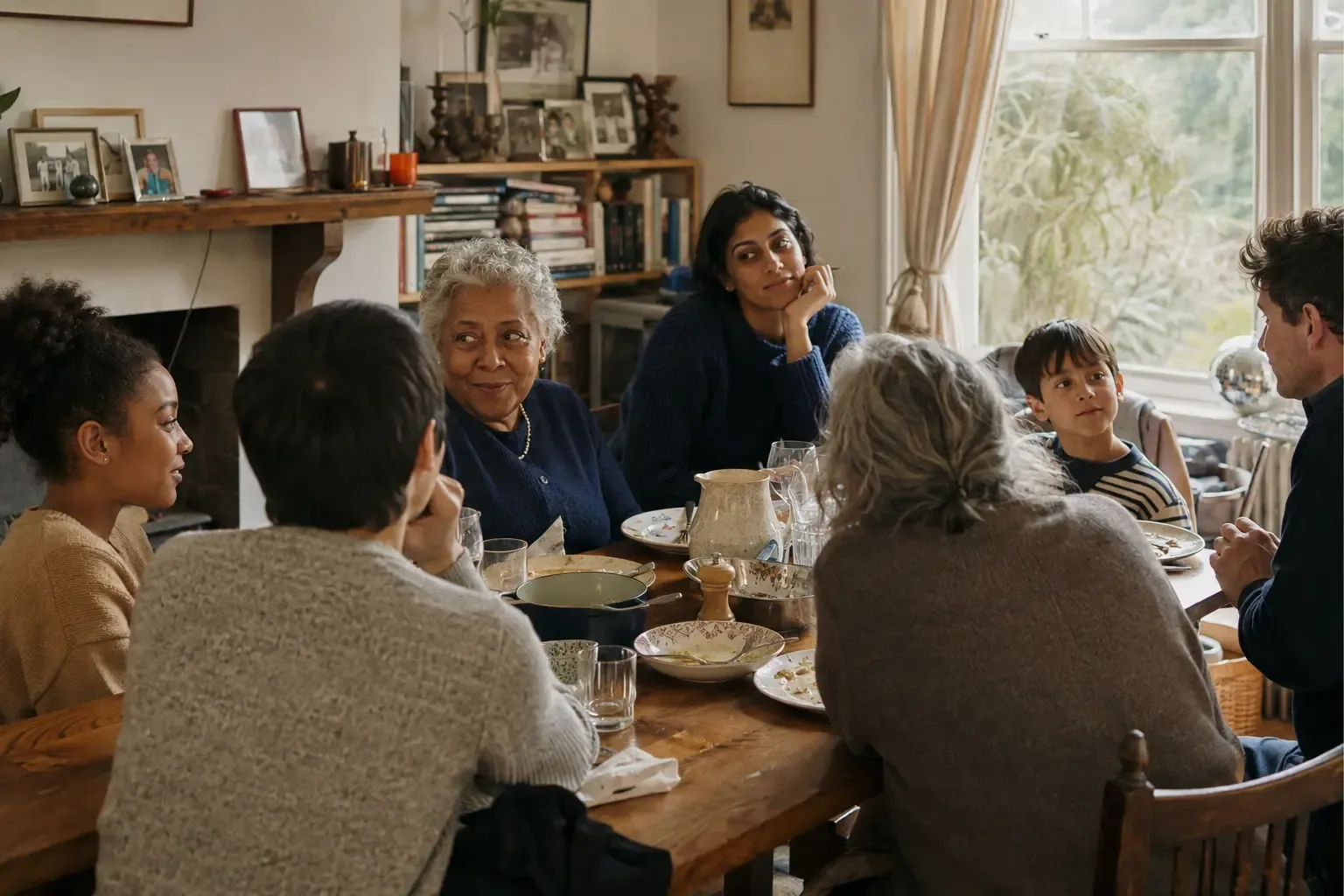
Family is the branch nobody selected. It arrives with history attached, and it keeps arriving: parents age, children grow out of needing you, roles quietly swap round while everyone pretends they have not.
It is also, for a great many people, the steadiest thing they have. Continuity, being known without explaining yourself, somebody who remembers who you were at nine. That belongs in the picture as much as anything difficult does.
Looking at family is not the same as reducing yourself to what you inherited. It is noticing what is running now, which parts of it you would choose again and where your responsibility actually starts and stops.
What this can help you notice
- What family gives you now, including the ordinary sustaining parts.
- Which responsibilities you took on deliberately and which simply landed.
- Where a role has changed without anybody saying so.
- What is genuinely yours to carry, and what is somebody else's life.
- Whether the way things are is fine and simply needed saying.
The book separates what a life began with from the life being lived now. Family sits in both, and the two are worth keeping apart.
Where people usually start
Reading, a few minutes
I feel responsible for everyone in my family.
You are the one people ring, and you are tired of the ringing.
Why it is relevant here: For when the load has grown by accumulation rather than by decision.
Reading, a few minutes
My children do not need me the way they used to.
The house is in order and it is too quiet to enjoy.
Why it is relevant here: A change of role rather than a loss of one, examined without sentiment.
Session, about 18 minutes
How am I showing up?
See where your time, attention and energy actually go.
Why it is relevant here: Looks at your own conduct inside the family rather than at everybody else's.
If you want to go further
Four things made by other people, chosen because they are useful rather than because they agree with us. None of them is homework, and none of them is a view TAIU is asking you to hold.
READ · Karl Pillemer
Fault Lines
Why this may be useful: Karl Pillemer interviewed hundreds of estranged and reconciled families, and is careful never to prescribe either outcome.
karlpillemer.com ↗ (Opens in a new tab)WATCH · Robert Waldinger
What Makes a Good Life?
Why this may be useful: The long study on what people value looking back, which reaches well beyond partners into family life.
ted.com ↗ (Opens in a new tab)READ · Merril Silverstein and Vern Bengtson
Intergenerational Solidarity and the Structure of Adult Child–Parent Relationships
Why this may be useful: Research on the many different shapes an adult child and parent relationship can take, none of them the correct one.
journals.uchicago.edu ↗ (Opens in a new tab)READ · Kristina Scharp
Making Meaning of Family Estrangement
Why this may be useful: A study of how people make sense of distance in a family, useful whether or not distance is what you want.
tandfonline.com ↗ (Opens in a new tab)
Reading it, and keeping it
Everything listed on this page can be read and worked through without an account. Nothing you write in a public session is sent anywhere or stored by us.
Signing in adds one thing: your own words stay, in My Tree, so that when you come back in six months you can see what you thought at the time rather than reconstructing it.
Take this in any order, or take one and stop there. Deciding that nothing needs changing is a real answer, and it is worth knowing why.