 Ask Alto
READ · BOOK
Family Routines and Rituals
Barbara Fiese
Fiese shows how much of family life is carried by small repeated practices rather than by decisions. Useful for seeing what you inherited without choosing.
Read more ↗
Was this useful?
Tool 38 · Develop yourself
A guided 18 to 22 minutes conversation, here in TAIU. No diagnosis, no invented childhood explanations and no requirement to break any cycle. Understanding a pattern is often the whole of the work.
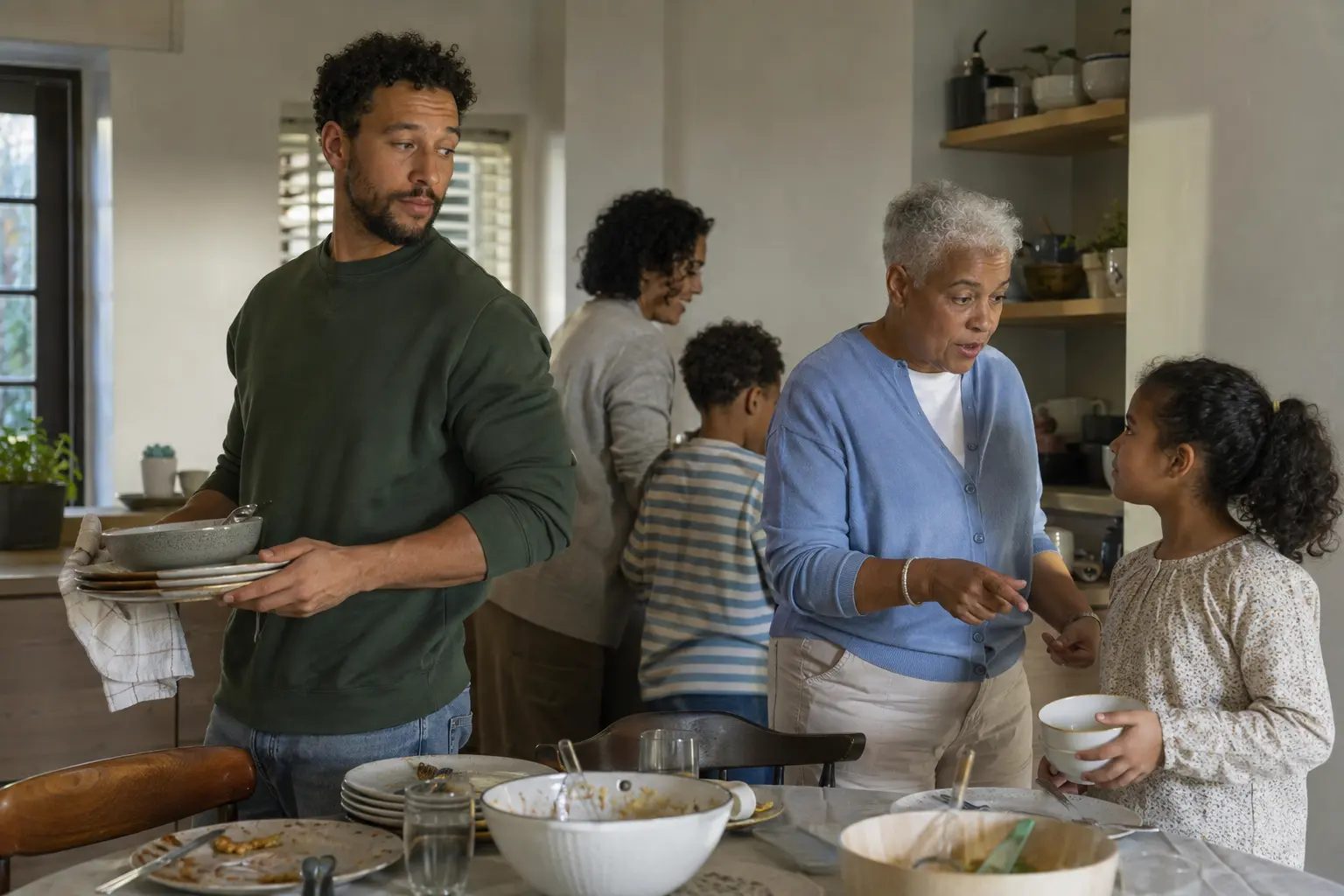
Most family patterns were sensible once. The circumstances left. The behaviour stayed.
Nobody describes their family from outside it, including you.
What you'll look at
A note from Mark

The trap with family patterns is that everybody who describes one places themselves outside it. The observer is always the reasonable one. In practice the person who left early every Christmas for fifteen years is a full participant in whatever is going on.
The question I find most useful is what the behaviour was for. Almost none of it is madness. Somebody controls information because in 1987 information caused a catastrophe. Somebody keeps the peace because the alternative was unbearable. The circumstances went and the behaviour stayed.
That reframes the whole thing. You are not looking at damage. You are looking at an old solution still running.
And there is no obligation to break anything. Some patterns are irritating rather than harmful, and knowing what is happening at the table is often the entire benefit.
What you'll get
01
What recurs
02
Your part in it
03
What it was for
04
Whether it still works
+
Your TAIU handover: a summary of what the conversation found, written so you can take it with you.
When you finish
Your tree is where TAIU keeps a picture of your whole life, in parts like work, money and health.
At the end, the conversation asks how Family and belonging feels for you right now, in your own words. It also asks what, if anything, would feel different. Nothing changes on your tree unless you say it changes.
The conversation writes this summary for you. Keep the sheet, print it or paste it into My Tree. Nothing from the conversation is stored by TAIU.
What now?
01 · Save it
What actually recurs, with real examples.
02 · Test it
Watch the next family occasion rather than participating in the usual way.
What I would do
Count occasions before naming anything a pattern.
Put yourself inside the pattern. There are no observers in families.
Ask what the behaviour was for. Most of it was adaptive once.
Separate inconvenient from harmful. Most of it is the former.
Allow understanding to be the whole result.
Test it
Has it happened four times, or twice and once nearly?
What role do you take without being assigned it?
What would the person you find most difficult say the pattern is?
The alternative
The expected conclusion is that the family is dysfunctional and the pattern should be broken. Frequently the evidence says something more interesting. A behaviour that looks irrational from outside was often an intelligent response to conditions at the time: money was controlled because there was almost none, peace was kept because the house could not survive another argument. The useful question is not whether it is healthy but whether it still works. Sometimes it does. Sometimes what looks like a pattern turns out to be three separate events that happen to resemble one another.
Think about this
Take this to Ask Mark
This looks at what you found and helps you understand it. It is not another exercise to repeat.
Take this to Ask Mark →READ · BOOK
Barbara Fiese
Fiese shows how much of family life is carried by small repeated practices rather than by decisions. Useful for seeing what you inherited without choosing.
READ · BOOK
Murray Bowen
Bowen's idea of differentiation, staying connected to your family without being governed by it, is the useful frame for most adult family questions.
READ · BOOK
Monica McGoldrick
The method for mapping a family across generations. It turns vague inherited feeling into something you can look at.
What helped you?
If you've read, watched, listened to or tried something that helped you think about this differently, we'd like to hear about it.
We review recommendations before sharing them with the community.
Finished the exercise?
Tell us whether it helped and what you discovered. It takes less than a minute.
Next tool
If the pattern is mostly about what you carry
Further thinking
Family Therapy in Clinical Practice
Murray Bowen
Genograms: Assessment and Intervention
Monica McGoldrick
Family Routines and Rituals
Barbara Fiese
Book
Murray Bowen
Bowen's idea of differentiation, staying connected to your family without being governed by it, is the useful frame for most adult family questions.
Book
Monica McGoldrick
The method for mapping a family across generations. It turns vague inherited feeling into something you can look at.
Book
Barbara Fiese
Fiese shows how much of family life is carried by small repeated practices rather than by decisions. Useful for seeing what you inherited without choosing.
Book
Froma Walsh
Walsh looks at what families do well under pressure. A necessary counterweight when you are only cataloguing what went wrong.