07 · People & life

How am I showing up?

There are people in your life who experience a version of you every day.

Your partner. Your children. Your parents. Your friends. The people you work with.

And then there is the version of yourself that you experience when everybody else has had their share.

The interesting question isn't simply whether you think you're doing a good job. What would they say?

Take an honest look →

About 15 to 20 minutes

A woman sitting slightly back from a busy family dinner table, holding a glass, her attention somewhere else

A guided 15 to 20 minute conversation using an AI you already have. Free, no account, nothing stored.

We spend a lot of time working on what we're becoming. Sometimes we should look at who we already are.

I've spent a lot of my life around ambitious people. I've also spent a lot of time being ambitious myself.

We measure businesses. We measure careers. We measure money. We measure whether somebody got the promotion, built the company, bought the house or achieved whatever they said they were going to achieve.

But I don't remember many people sitting down and asking themselves whether they're being a good son.

Or a good father. Or a good sister. Or friend. Or partner.

And perhaps more importantly, what does good actually mean to the person on the other side of that relationship?

I've had conversations with people who are doing extremely well in one part of their life and, when you start asking about everything else, they realise something has quietly disappeared. They haven't seen their friends. They rarely call their parents. They are permanently working. They have put almost all of themselves into a relationship. Or they spend so much time looking after everybody else that there isn't much of them left.

I don't think the answer is to try to become a ten out of ten at everything. You can't. There are only so many hours in a week and only so much attention you can genuinely give.

The more interesting question is whether where you're putting that attention reflects the life you actually want.

And there is another side to this. Sometimes improving your life isn't about adding anything. It might be about stopping something. A commitment you no longer care about. A relationship you maintain almost entirely through guilt. A project that has been going nowhere for years. People who repeatedly take much more from you than they give. Or simply a habit that is consuming hours of your life without you ever consciously choosing it.

That doesn't mean cutting everybody off the moment they become difficult. Relationships have difficult periods. Families have responsibilities. People need us. Sometimes we need to give more than we receive.

But occasionally you need to look at your life from above and ask: where is all of me actually going?

That's what I want this exercise to help you see.

Who gets the best version of you?

And who gets what's left?

Attention is finite.

There is a comforting idea that with enough organisation we can fit everything in. A successful career. A close relationship. Present parenting. Good friendships. Family. Exercise. Learning. Community. Travel. Rest. And somehow a little time for ourselves.

Real life doesn't work quite like that.

Every yes occupies time that cannot be spent somewhere else. Every relationship needs some degree of attention if it is going to remain a relationship. Every responsibility takes something.

The question therefore isn't how to give everything more. It is: what deserves more of me now? And equally, what deserves less?

Priorities change. The people and responsibilities that matter when you are twenty may not be the same when you are forty, sixty or eighty. Having children changes things. Losing someone changes things. Building a company changes things. Age changes things.

Sometimes a relationship that once mattered enormously naturally becomes less central. Sometimes somebody we assumed would always be there suddenly reminds us that time isn't unlimited.

This isn't an exercise in guilt. It is an exercise in allocation.

Who are you trying to be?

The exercise starts by asking which roles genuinely matter in your life today. There is no fixed wheel to fill in, nothing is compulsory, and you can add your own. Someone who has chosen not to have children shouldn't be shown a missing category, and you may hold several of these roles with the same person.

  • Parent
  • Partner
  • Son or daughter
  • Brother or sister
  • Friend
  • Leader
  • Colleague
  • Carer
  • Mentor
  • Community member
  • Me

First reflection

How do I think I'm showing up?

Score 0 to 10.

Then

What score do I think they would give me?

The gap between the two numbers is usually where the conversation goes.

Questions worth stopping on.

  • 01

    Who gets the best version of you?

  • 02

    Who gets what's left?

  • 03

    Who would you regret having neglected if life changed unexpectedly tomorrow?

  • 04

    Who do you spend time with because you want to, and who largely through habit, guilt or obligation?

  • 05

    What do people repeatedly ask from you that you keep failing to give them?

  • 06

    Who gives a lot to you while receiving surprisingly little back?

  • 07

    Who are you repeatedly giving to without receiving what you reasonably need?

  • 08

    What part of your life gets far more time than you intended?

  • 09

    What commitment would quietly disappear if you had 20 percent less time next year?

  • 10

    What do you keep doing mainly because you've already invested so much in it?

  • 11

    Who leaves you feeling more like yourself after spending time with them?

  • 12

    What consistently leaves you depleted, resentful or smaller afterwards?

  • 13

    When you have free time, does any of it actually belong to you?

If the people closest to you described your priorities from your behaviour rather than your words, what would they say matters most to you?

You don't need to answer all of these. The exercise works out which of them actually apply to your life.

Look at the whole picture.

You don't need to prepare anything.

The exercise will first understand the roles and relationships that actually matter in your life. Then it will look at where your time, attention and emotional energy are going. It will ask you to compare how you think you're showing up with how the other person might experience you.

It may challenge some of your scores. It may also tell you that something you're criticising yourself for doesn't appear to be the real problem.

The objective isn't to produce the highest possible life score. It is to find the few things worth changing.

TAIU showing up exercise · 15 to 20 minutes

Paste it into ChatGPT, Claude, Gemini or another capable AI platform. Start by answering honestly rather than trying to give the right answer.

Four things it might tell you.

  • 01

    Invest more

    Important, but currently receiving too little of you.

  • 02

    Protect

    Important and already working. Recognise it rather than optimising it.

  • 03

    Change

    Important, but the current pattern isn't working. This may need a conversation, an expectation or a boundary.

  • 04

    Reduce or release

    Taking disproportionate time, attention or energy without enough reason to continue in its current form.

Not everybody or everything needs a label. Reducing an activity is also very different from ending a relationship, and the exercise is built to treat that distinction carefully.

People have studied this for a very long time.

Decades of research on relationships, attention and how our priorities change across a life sit behind this exercise. You don't have to read any of it, but if something surfaces that you want to understand properly, start here.

01

The Good Life

Book · Read

Robert Waldinger & Marc Schulz

The Good Life

Best for: Understanding why relationships deserve serious attention

The Harvard Study of Adult Development has followed lives across decades. One of its clearest lessons is that the quality of our relationships matters enormously to how our lives unfold.

Why I'd recommend it

If achievement has gradually pushed relationships towards the edges of your life, this is a useful place to reconsider what deserves to be near the centre.

02

Four Thousand Weeks

Book · Read

Oliver Burkeman

Four Thousand Weeks

Best for: Accepting that you cannot fit everything in

The title comes from a simple observation. An average human life is surprisingly short when expressed in weeks. Burkeman challenges the idea that becoming more productive will eventually create enough time for everything. It won't.

Why I'd recommend it

Read this if your problem isn't knowing what matters. Your problem is trying to make everything matter at once.

03

Together

Book · Read

Vivek Murthy

Together

Best for: Loneliness, belonging and rebuilding connection

Loneliness isn't always about physically being alone. People can be surrounded by colleagues, family or social activity and still lack relationships in which they feel genuinely known.

Why I'd recommend it

Particularly useful if the exercise reveals that you've become socially busy but personally disconnected.

Ask them.

There is an obvious limitation to rating yourself as a partner, parent, friend or colleague. You're asking yourself.

At some point, the person on the other side of the relationship knows something you don't. If the relationship is appropriate and it feels safe to do so, choose one or two people who matter and ask them.

  • What do I do that makes you feel valued or supported?
  • What do you wish I did more of?
  • Is there anything I do that makes our relationship harder than it needs to be?
  • When do you feel you get the best version of me?

Don't defend yourself. Don't explain the score you gave yourself. Listen. You can always bring what they tell you back into the exercise.

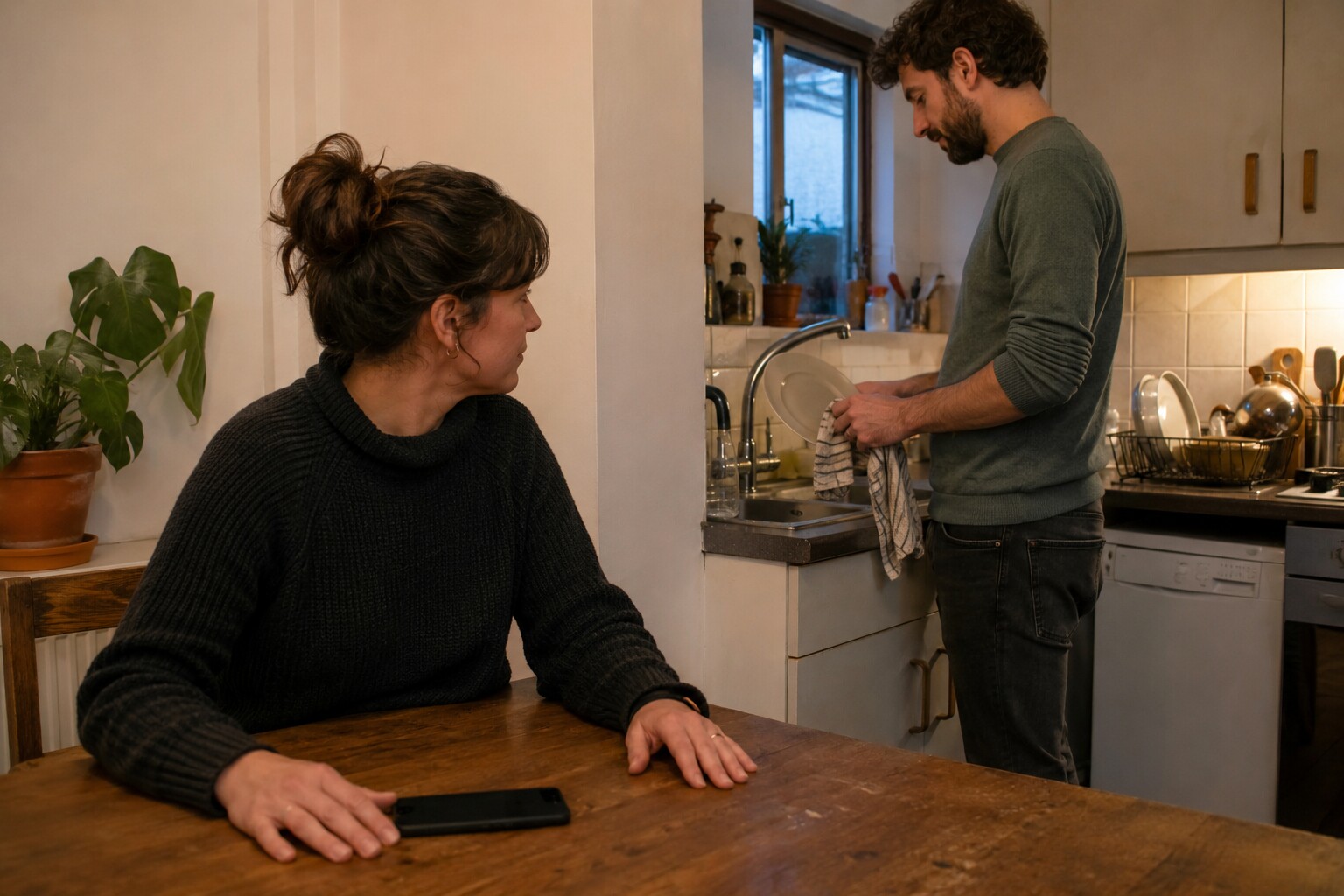
Two people at a kitchen table in the morning, one speaking and the other listening closely over mugs of tea

Don't try to fix your whole life.

If this exercise gives you fifteen things to change, it has failed.

A useful result should be smaller. Something you can actually do.

  • One person to invest in

    Who deserves more deliberate attention, and why.

  • One conversation to have

    Something that needs to be understood, said or heard.

  • One thing to reduce

    A commitment, activity, habit or pattern taking disproportionate energy.

  • One thing to protect

    Something important that is already working.

  • One thing for me

    Time or attention deliberately allocated to something you value for yourself.

  • One action this week

    Specific and achievable, small enough that you will actually do it.

Imagine being able to look back.

Not at how busy you were. Not at how many exercises you completed.

But at whether the things you said mattered actually received more of you. That's one of the ideas behind My TAIU.

My TAIU: future product direction. Nothing is stored today.

Then look again

  • Did my attention actually move?
  • Did I have the conversation?
  • Did the relationship change?
  • Did reducing something create space for something better?
  • Was my original interpretation correct?
  • What did the other person tell me that I couldn't see myself?

Worth revisiting after about 30 days. The important question isn't whether you completed an exercise. It's whether anything changed.

My showing up map

THE ROLES THAT MATTER TO ME
The roles you consciously chose.
HOW I'M SHOWING UP
Your own assessment.
HOW THEY MAY EXPERIENCE ME
The most important perception gaps.
WHAT THE EVIDENCE SAYS
Behaviour rather than intention.
WHAT I'M DOING WELL
Areas worth protecting.
WHERE I'M UNDERINVESTING
Important things receiving too little.
WHERE I MAY BE OVERINVESTING
Where disproportionate attention is going.
WHAT IS TAKING TOO MUCH FROM ME
People, commitments, activities or patterns.
WHAT I WANT TO CHANGE
Your conclusion.
ONE PERSON TO INVEST IN
Specific.
ONE CONVERSATION TO HAVE
Specific.
ONE THING TO REDUCE
Specific, where appropriate.
ONE THING TO PROTECT
Specific.
ONE THING FOR ME
Specific.
THIS WEEK
One action.
THE ALTERNATIVE
The strongest alternative interpretation uncovered.
30 DAY REVIEW
What to look at again.

The exercise produces this as plain text at the end, so you can copy it and keep it.

Some relationships need people, not a tool.

This exercise is designed to help you think about the ordinary difficulty of giving your time and attention to the people who matter.

If a relationship involves abuse, coercion, violence or fear, or if you are in serious distress, the normal exercise stops. It will not encourage you to confront somebody where that could put you at risk, and it will not tell you to end or repair a relationship on the basis of a short conversation.

At that point the priority is safety and appropriate real world support.

Finished the exercise?

What did this uncover?

Tell us whether it helped and what you discovered. It takes less than a minute.

If this uncovered something deeper

Your attention is your life in practice.

What we say matters is interesting. Where we put our time is usually more revealing.

You won't be able to give every person, ambition, responsibility and interest everything it asks from you. Nor should you. The point is to choose more consciously.

Invest where something matters. Protect what's already good. Change what isn't working. Reduce what is taking too much.

And occasionally ask the people you care about whether the version of you they experience is the version you thought you were giving them.

TAIU showing up exercise · 15 to 20 minutes

Paste it into ChatGPT, Claude, Gemini or another capable AI platform. Start by answering honestly rather than trying to give the right answer.